

As Head of Climate Action at Upgrade Estate, Jeroen has one clear objective: to make the organisation fully CO₂-neutral by 2035. That is fifteen years ahead of the target set by Europe under the Green Deal. Ambitious? Absolutely. In this blog, he shares his story, his drive, and how we are building a more sustainable future step by step.
How are you feeling today, Jeroen?
Very good! The sun is shining and there’s plenty of wind… In short: perfect weather to talk about renewable energy. Solar and wind energy give me energy — literally and figuratively. It immediately makes me think of our ambition to become fully CO₂-neutral by 2035.
Europe has set 2050 as the deadline, but we deliberately chose a much more ambitious goal. And yes, it’s challenging. The first few years are the toughest because so much needs to be initiated. But I strongly believe we can make it happen.
What actions have you already taken?
One of the first major steps was electrification. We aim to reduce our gas consumption to zero. All buildings delivered since 2020 are already gas-free. For our existing buildings, we continuously assess opportunities to electrify. We have already fully converted one existing building to electricity — an important milestone we are particularly proud of.
The more we electrify new buildings, the better we can apply these techniques to existing projects. Our CO₂ strategy is structured around three scopes:
- Scope 1: direct emissions such as gas consumption
- Scope 2: indirect emissions from electricity use
- Scope 3: the entire supply chain
It is within Scope 3 that we currently face the greatest challenges. Our new projects are still often built using concrete and steel, but shifting to timber construction projects can reduce CO₂ emissions by up to 80%.
A shift to timber construction can reduce CO₂ emissions by up to 80% - Jeroen
Renovations also play a key role. Projects in the pipeline that are being renovated result in significant CO₂ reductions because the existing concrete and steel are preserved. It is not only more sustainable, but also a smart way to give buildings a second life instead of demolishing them entirely.
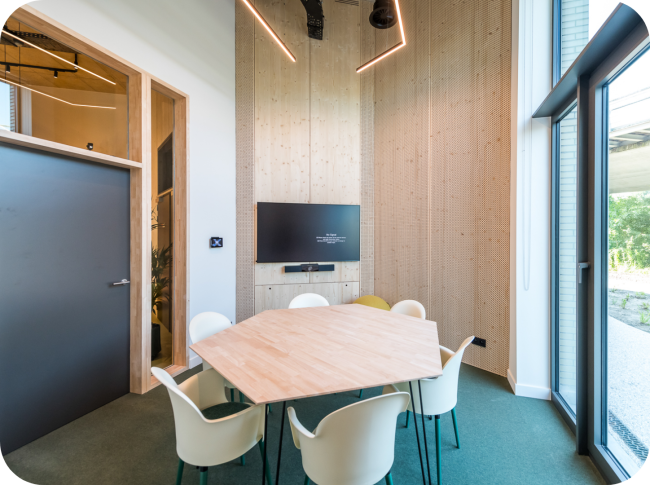
Another important development is the increasing use of wood during the finishing phase. In our Upoffiz project, for example, all shared meeting rooms are built with wooden interior walls. For new projects in the pipeline, we are also exploring how elements such as façade cladding can be fully executed in wood.
Transitioning to timber construction requires a significant amount of wood. That is why we invest in forests in Finland to sustainably secure the necessary raw materials. But wood alone is not enough. Successful timber construction projects also require wooden walls and ceilings that are ready for integration into buildings. Permits also play a crucial role.
Timber construction presents challenges in terms of fire safety, which can make obtaining permits in the short term a stumbling block.
We have already completed a first small-scale timber project to gain experience. Within two to three years, we expect to implement this on a larger scale in collective, gas-free projects. This knowledge can also be applied to existing buildings, making our real estate portfolio increasingly sustainable.
Do I believe we can be fully CO₂-neutral by 2035? Absolutely. With all the steps we are taking — electrification, renovations, timber construction and renewable energy — we are firmly on track.
How far along are we with our forestry project?
Internally, we call it our B-to-B strategy: from forest to building. In Finland, we have already acquired several forests, and a third one of 68 hectares will soon be added. Our goal is to acquire at least 100 hectares every year.
Why? Because we want to manage timber sustainably. We ensure that the volume of wood in our forests increases or remains stable. We apply pick harvesting, meaning only trees that are ready for harvest are cut down. This keeps the forest healthy and resilient.
Harvesting takes place locally, as does processing. Transporting the wood to Belgium is not sustainable as long as CO₂-neutral shipping is not available. Therefore, we purchase wood locally here. The wood from our Finnish forests is processed locally in collaboration with sustainable partners. Forest management in Finland not only provides us with timber, but also with valuable expertise to further scale up timber construction projects.
Our goal is to acquire at least 100 hectares every year - Jeroen
How do you measure progress towards 2035?
We measure virtually everything ourselves, which gives us a major advantage: we know exactly what each building consumes, down to fifteen-minute intervals. This allows us to clearly see how much gas was previously consumed and how much electricity is now being used. The shift is evident: gas consumption is declining towards zero, while electricity consumption is rising exponentially.
All that remains is to convert this consumption into CO₂ emissions using a conversion factor. This allows us to accurately track our progress towards carbon neutrality in 2035.
We do not only look at individual buildings, but at the organisation as a whole. Depending on how many projects we deliver and how they are built, we see stronger or more moderate decreases in consumption and emissions. Major changes are still ahead, such as the transition from concrete and steel to timber construction projects. These are truly significant steps that will have a major impact on our sustainability goals.
Of course, reducing energy consumption alone is not enough. We also need to generate that energy as sustainably as possible. That is why we are heavily investing in solar parks and wind turbines.
How far along are we with solar and wind energy?
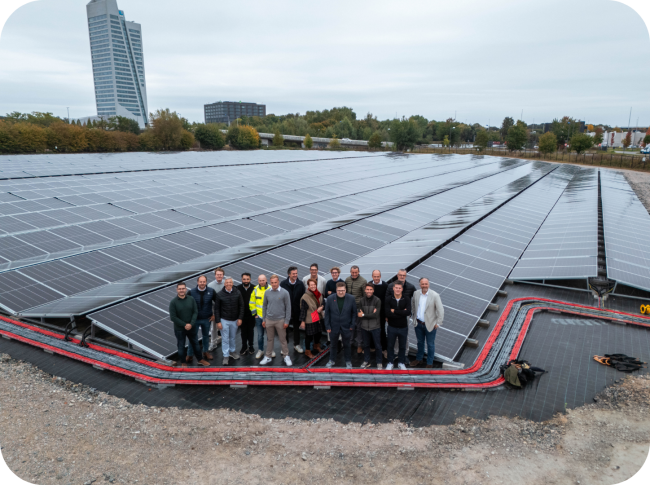
We have obtained permits for two large solar parks. The first solar park, located at The Loop in Ghent, has been operational since October 2025. It is one of the largest solar panel parks in Ghent, generating 5.5 MW of green energy across 31,400 m².
With 8,078 solar panels — equivalent to the energy consumption of 1,400 households — the park supplies 80% of the energy needs of our Upoffiz | Upliving Ghent - Loop5 campus. Our brand-new Wing Upkot project also benefits from renewable energy generated by our solar farm. That is exceptional, and we are rightfully proud of it. In addition, we share the generated energy through our own energy community, allowing other buildings in Flanders to benefit as well.
Sunlight alone is not enough, especially at night and during winter. That is why we are also working on four development tracks for a total of five wind turbines. These will not only cover our own consumption, but potentially also allow us to supply energy to our stakeholders.
Want to make an impact?
Interested in working at Upgrade Estate? Check the open vacancies and maybe you’re the perfect match!