

Upgazet: What you pass on without realising it
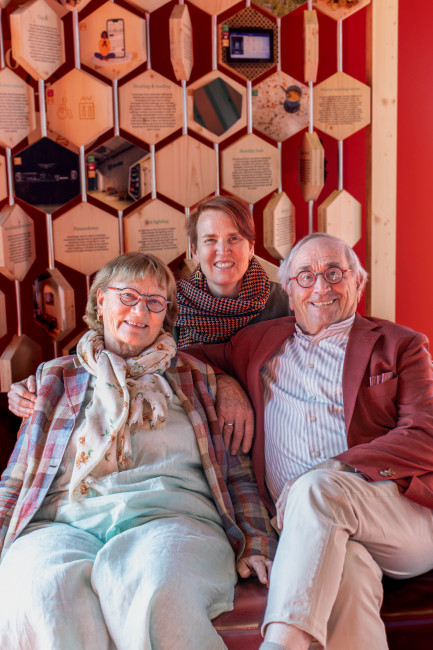
Paul and Erna, both 76 and parents of co-CEO Nele, once combined a florist's shop with a thriving graphic design business and the rental and management of several student houses. ‘During the day, finishing leaflets with fifty people, in the evening unblocking a toilet in Ghent.’ For one day, they immersed themselves in their daughter's business with sometimes astonished looks and sparkling eyes.
What was your first impression today, based on your own background as entrepreneurs?
[Erna] What immediately struck me was how big and structured everything is here. In the past, we used to make decisions just the two of us. Here, there are so many colleagues and so many consultation meetings... That requires a completely different way of working. And then there's that idea of “being happy”. We were already happy when there was work. Now it seems as if happiness is something that you, as an employer, have to guarantee. But what is happiness, really? For me, it's still being satisfied with the simple things.
Everything is discussed and everyone is listened to. That used to be different. (Paul)
[Paul] For me, it was mainly the speed that stood out. Everything moves at such a fast pace here! And then there are the meetings and deadlines. Everyone has to be kept happy. Whereas back then, we were mainly focused on getting the work done. The mentality has changed. People have become more demanding. In our day, you didn't get a car; you were just happy to have a job. Now you hear: ‘If I don't get a car, I'm not coming.’ That's a different era.
[Erna] And yet, some things remain the same. Students are still students: a lost key, a blocked shower...
[Paul] ... or a blocked toilet on Sunday evening (laughs). Only now they often solve that here with a team and partly digitally.
And how did tenants react at the time?
[Paul] Technical problems were quite common: a blocked toilet, the heating breaking down or the internet going down. If it wasn't fixed quickly, we immediately got a call from the parents. ‘Come on, it's still not fixed?’ ‘We're paying for it, aren't we?’ Students have always been assertive, that hasn't changed.
[Erna] Still, we had a good relationship with our tenants. We would stop by every Monday evening to say hello and knew them by name. We are still in touch with some of them today. What has changed, however, is patience. Digitalisation has changed expectations. If you order something on Bol.com, it arrives the next day. People are used to that. They want everything quickly.
What surprised you today when you spent the day with us?
[Paul] What struck me was how open the communication is. Everyone can have their say. Everything is discussed and people listen to each other. That used to be different.
[Erna] What I liked was that employees can freely share their opinions, even with Nele and Koenraad, who in turn listen. There is openness and respect. In the past, as a boss, you were more demanding: this and that had to be done. Now you see that managers sometimes have to treat people with kid gloves. That takes some getting used to.
[Paul] I think I would have had trouble with that in the past. Young people have grown up expecting to get everything immediately. Everything has become a matter of course. Not everyone, of course; there are also young people with the “right” mindset. But the difference is huge compared to the past.
What do you think you have passed on to Nele as the next generation? Do you see elements of your approach or values reflected in the company today?
[Erna] The way they deal with tenants and organise everything today, I do recognise things from our company in that. Small details perhaps, but still. I think we have been a bit of an example, without consciously striving for that.
[Paul] Honesty, openness, being fair. We have always considered these things important. If you are fair, you can say and do a lot. But if you lie, trust disappears. These are things that you may not consciously pass on, but which are passed on nonetheless. And people from outside the company sometimes say to us: ‘You can see that it comes from your nest.’ That's when we really think about it.
[Nele] What I've mainly learned from home is to use common sense and be solution-oriented. I feel best when I can tackle and solve a problem. That's really ingrained in me.
[Paul] And also hard work. In our family, we never talked about hours. If something needed to be done, you just did it. Not against our will. It was part of the job. We see that in them now too.
Is there any advice you could or would like to give today?
[Paul] Gosh, that's difficult. They're already much smarter than me (laughs). But if I had to say something, it would be: keep focusing on the human aspect. Everything is becoming so digital and impersonal. They sense that, but it's still important to be mindful of it.
[Erna] Companies that focus solely on the digital and lose sight of the human aspect? I don't think that can continue to work. People want to be addressed and seen.
[Nele] For us, technology is intended to support a people-oriented approach. It helps with repetitive tasks that don't make people happy anyway. But everything that has to do with real connection is handled by people at our company.
[Erna] I used to always ask the students questions. ‘What are you studying?’ ‘How many more years do you have to study?’ And then they would take off their headphones and start chatting.
Companies that focus solely on digital and lose sight of the human aspect? I don't think that can continue to work. People want to be addressed and seen. (Erna)
[Paul] Those spontaneous chats are so valuable. Young people are less inclined to do that these days. Even finding a partner has become difficult. (laughs)
[Nele] I recognise that. When we were working on a digital tour via audio tour, I noticed that the initial chat was missing. That personal welcome moment. I immediately made adjustments, and on the next rental day, a student was baking pancakes in the entrance hall, with music playing in the background. That's the essence for us: creating an experience that sticks. You use technology where it adds value, but you always start from the human aspect.
What inspired you most today?
[Erna] Human contact, definitely. We already know a lot of people here, and I feel that it's a good fit. That's nice to see.
[Paul] For me, it was the motto “everything in its own time”. I saw that today too: everything here runs with the right energy.
[Erna] Staying open to what's happening around you is important to me. Staying curious.
[Paul] We like to surround ourselves with young and older people, as long as they have a positive attitude. We can learn a lot from both generations.
Read our digital Upgazet
Curious to discover the stories across generations within Upgrade Estate?