

Nils has been on board at Upgrade Estate for almost 20 years, making him the Upgrader with the most seniority. His career spans several generations. He worked with pioneers from the very beginning and over the years saw how young entrants strengthen the company with their own habits and expectations. Today, as Chief Commercial Officer, he leads the commercial section, focusing on sales, marketing and business development. In this interview, he looks back on the past two decades and what he thinks really matters in order to stay connected to yourself, your colleagues and the company.
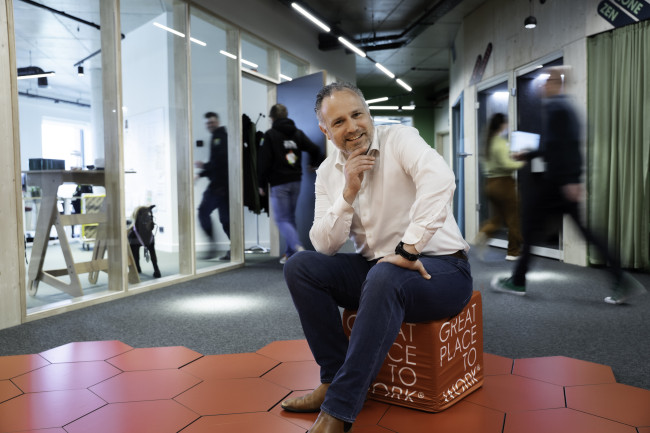
What generational differences have you noticed at Upgrade Estate over the past two decades? Have expectations changed?
I don't care much about generational differences and have always tried to just stay myself. I like working with different generations. That exchange just keeps me sharp. I also think people are less different from each other than is often thought. Everyone relates to other generations as a child, parent or colleague. That provides recognition. The context did change: digital tools, pace, resources. But the essence remains the same. I remember when I started working with a fax machine as a CRM system. Interested parties sent back a coupon via our fax and I called them. Today, we send an e-mail and get one back. Different tools, same intention. While celebrating 25 years of entrepreneurship of Nele & Koenraad (co-CEOs Upgrade Estate), we joked about this. On a tandem, we toured past old realisations. At my stop at the end, I pulled out big pictures of how it started, one of which was our fax machine. I want to keep telling that story. The start-up mentality back then is different from today's, but we must not lose that spirit. In terms of expectations, I see little difference between generations. Some people think it will come naturally, others know they have to prove their worth first. That was true 25 years ago and it is still true today.
That fear of just calling someone up, I find striking.(Nils)
Do you notice differences between generations in how they organise or communicate?
For example, what we notice with older customers is that they are finding it increasingly difficult to cope with digitalisation. As a company, we are fully committed to customer focus and personal contact, but digital tools are increasingly being integrated to support. Our processes are also becoming more digital, think of communication via e-mail or digital platforms. For customers aged 80+, this is sometimes difficult. That remains a small group, but it plays. At the same time, we feel just how hard people long for personal contact, especially on important matters. We often hear, ‘I don't know who my contact at the bank is, I can't call anymore, I'm sent from pillar to post.’ This is fundamentally different with us. We just start from that personal relationship. That is really appreciated. Alongside the coMerkers, I see that younger people often have a fear of simply calling, whereas a short phone call often provides more clarity and nuance. That trepidation to pick up the phone seems difficult to train away. That fear of just calling someone, I find striking.
What I like best is seeing young people grow in what they do. (Nils)
How have you yourself evolved over the past 19 years and what do you learn from working with younger colleagues within your team?
I think I have always consciously chosen not to lose my playful nature. That typifies me. I don't take myself too seriously and that helps put life into perspective. At the same time, I did become calmer, I don't get upset as easily. You learn to deal with people who leave, including people you would rather have kept, or with situations where you have to have difficult conversations yourself. That human aspect affects me, but I have also become more resilient. What I have never lost is my enthusiasm. For me, that is crucial. The atmosphere, the dynamics, the feeling of building something together. Should it become too corporate, that enthusiasm would disappear. The mentality of old -small, familial, creative- I want to keep that. Our team today is quite young, in their early thirties on average. What I like best is seeing young people grow in what they do. They have grown up in a digital world, and that makes a huge difference. Their take on social media, trends and platforms strongly determines how our brands come out. Without them, we would quickly become irrelevant. They are independent and responsible which means they show me what I don't see myself. That is worth its weight in gold.
What would you like to pass on to new generations starting today? How do you see core values and cooperation between generations reflected concretely in the company?
Going step by step is the best advice I can give. You get further with regularity and dedication than with suddenly wanting to jump too far. It's important to stay close to your talent, feel where your flow is and take that seriously. And also: leave each day with the thought that it could be your last working day. That helps not to take your efforts for granted. Anyone starting here should be aware that working at Upgrade Estate also means committing to a culture. About a third of your life is spent at work. So make something of it. Look not only at generations, but also at life stages. Someone of 25 is in life differently from someone of 50 and that deserves respect either way. One of the values we remain committed to is collaboration. We recruit on that: 50% skill fit, 50% culture fit. Someone can be super technically, but if the click is not there in terms of values or team dynamics, it usually doesn't work out. Our corporate culture has become strong, almost self-correcting. Whoever fits in, grows. Age plays no role in this. For me personally, the co-brand comics remain magical. Every time again. Taking a break from routine together with colleagues young and old. That is the oxygen you need to keep building with enthusiasm for a whole year.
Read our digital Upgazet
Curious to discover the stories across generations within Upgrade Estate?